
May 27, 2026
Sepolo PointGuard: AI-Powered Condition Monitoring For Railway Point Machines And Turnouts
PointGuard helps rail operators monitor railway turnouts and point machines by turning every movement into condition intelligence. Instead of only showing whether a point machine worked or failed, PointGuard captures the current profile, cycle duration, movement signature and operational history of each movement, then compares it with the learned baseline for that specific asset. The solution helps maintenance teams identify early changes such as slower cycle times, higher current draw, unusual movement tails, drift from normal behaviour and suggested anomalies. AI analytics support trend prediction and prioritization, while human review allows engineers to confirm, tag or dismiss anomalies so the system becomes more useful over time. PointGuard connects monitoring data with practical maintenance workflows through dashboards, API access, Power BI, webhooks and mobile apps. Developed in cooperation with RapidRail KL in Kuala Lumpur and already in production, PointGuard gives railway teams better evidence before small changes become failures, delays or costly disruptions.
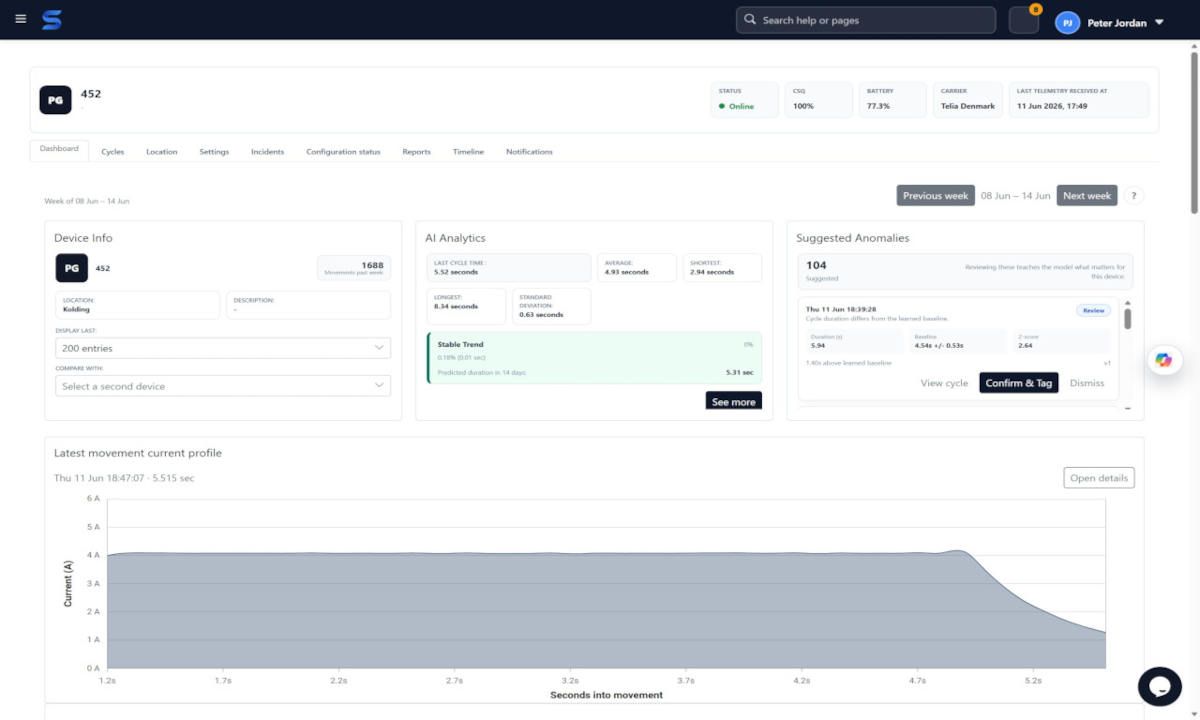
Railway turnouts are among the most important assets in rail infrastructure. When a point machine works correctly, trains move safely and efficiently through junctions, depots, sidings and complex track layouts. When a point machine starts to behave differently, the impact can quickly become operational: delays, callouts, maintenance pressure and in the worst case disruption to service.
The difficulty is that many point machine problems do not appear suddenly. They often begin as small changes.
A movement takes slightly longer. The current draw rises. The end-of-movement tail changes. The motor works a little harder than usual. The cycle still completes, so the issue is easy to miss.
This is exactly where PointGuard is designed to help.
What Is PointGuard?
PointGuard is a railway turnout and point machine condition monitoring solution that captures, analyzes and learns from every point movement.
Instead of treating a point machine as simply “working” or “not working,” PointGuard looks at the detailed behaviour of each movement. It records the electrical current profile, cycle duration, movement signature and operational history so maintenance teams can understand how the asset is behaving over time.
The goal is simple:
Turn every point movement into condition intelligence.
PointGuard helps railway operators, infrastructure owners and maintenance teams move from reactive fault response toward evidence-based and predictive maintenance.
Why Point Machine Monitoring Matters
Point machines are mechanical and electrical systems operating in demanding environments. They can be affected by many factors, including:
- Mechanical resistance
- Obstruction
- Wear
- Poor adjustment
- Motor condition
- Weather exposure
- Temperature changes
- Power supply issues
- Lubrication problems
- Track movement
- Ageing components
A traditional inspection may confirm the asset condition at a point in time. But point machines can move many times between inspections.
PointGuard adds continuous operational evidence. Every movement becomes part of the condition history.
Latest Movement Current Profile
One of the most important PointGuard views is the latest movement current profile.
This shows the electrical current drawn during a point movement. The vertical axis shows current in amps, and the horizontal axis shows seconds into the movement.
A healthy movement often has a recognizable shape. The current may rise, settle into a working phase, and then fall away as the movement completes. If friction increases, if the motor is under stress, or if the mechanism behaves differently, the current profile may change.
PointGuard makes that change visible.
This is important because a point can still complete its movement while already showing early signs of change.
Movement Signature Metrics
PointGuard does not only store a graph. It also extracts explainable movement signature metrics.
Examples include:
- RMS current: a useful summary of effective current draw
- P90 current: the current level below which 90 percent of samples sit
- Area: current over time, which helps describe electrical effort
- Ramp down: how the current falls near the end of movement
- Tail: the end-of-movement behaviour
- Clipped percentage: whether part of the signal reaches measurement limits
- Samples: the number of measurement points in the profile
These metrics allow PointGuard to compare one movement with previous movements and detect whether behaviour is stable or changing.
Cycle Duration Trend
Cycle duration is one of the clearest indicators for maintenance teams.
If a point normally moves in around 4.8 seconds and then begins to move in 5.9 seconds, that difference matters. It may not prove a fault on its own, but it is evidence that the asset deserves attention.
PointGuard tracks cycle duration across the day and across longer periods. This makes it easier to see:
- Normal cycle behaviour
- Spikes
- Outliers
- Gradual drift
- Repeated slow movements
- Changes after maintenance
- Assets that behave differently from their own baseline
The key phrase is their own baseline. PointGuard is not only comparing every point machine to a generic average. It learns what is normal for the individual asset.
AI Cycle Prediction
PointGuard includes AI analytics for cycle prediction.
The system can look at recent history, calculate trend behaviour and estimate expected future movement duration. For maintenance teams, this creates an early planning signal.
The prediction is not a magic promise that a component will fail on a specific date. That would be the wrong way to use AI in railway maintenance.
Instead, PointGuard uses AI to help answer practical questions:
- Is this asset stable?
- Is the cycle duration drifting?
- Are recent movements unusual?
- Should this point machine be reviewed before the next planned inspection?
- Which assets deserve attention first?
That is where AI becomes useful: not as a replacement for engineering judgment, but as a way to focus attention.
Suggested Anomalies And Human Review
PointGuard includes a suggested anomaly workflow.
When the system detects that a movement differs from the learned baseline, it can suggest an anomaly for review. The user can inspect the cycle, compare it with baseline values, view the z-score and decide what to do.
The workflow supports actions such as:
- View cycle
- Confirm and tag
- Dismiss
This matters because railway maintenance is not a fully automatic decision process. Context matters. A signal may be unusual but explainable. Another may indicate a real maintenance concern.
By allowing users to confirm, tag or dismiss anomalies, PointGuard creates a human-in-the-loop learning process. The system becomes more useful as the team teaches it which changes matter.
From Monitoring To Maintenance Workflow
PointGuard is not just a graphing tool. The value comes from connecting condition data to operational maintenance decisions.
A useful PointGuard workflow looks like this:
- Capture the movement
- Build the current profile
- Extract movement signature metrics
- Compare with learned baseline
- Detect duration or profile anomalies
- Review suggested anomalies
- Tag meaningful events
- Prioritize maintenance
- Use the history for follow-up and reporting
This gives maintenance teams a more structured way to move from raw signal to action.
Data Access: API, Power BI, Webhooks And Mobile Apps
PointGuard data should not be locked inside one screen.
The platform is designed to make data accessible through several channels:
- API access for integrations and enterprise systems
- Microsoft Power BI for dashboards and reporting
- Webhooks for automated event-driven workflows
- Mobile apps for field teams and on-site review
This is important because railway organizations often already have systems for asset management, maintenance planning, reporting and operational workflows. PointGuard is most useful when its data can support those existing processes.
In Production With RapidRail KL
PointGuard has been developed in cooperation with RapidRail KL in Kuala Lumpur, Malaysia, and is already in production.
That is an important point.
This is not only a theoretical idea about predictive maintenance. PointGuard has been shaped with real rail operational feedback and is being used in a production context.
For new railway customers, that means the discussion is about adapting a live product and workflow to their assets, processes and maintenance priorities.
Who Should Look At PointGuard?
PointGuard is relevant for organizations responsible for:
- Railway point machines
- Turnouts
- Switches
- Depot points
- Mainline junctions
- Light rail infrastructure
- Metro infrastructure
- Rail maintenance contracts
- Condition monitoring programs
- Predictive maintenance projects
- Asset reliability programs
It is especially relevant where teams want earlier warning, better evidence and clearer maintenance prioritization.
Why PointGuard Is Different
The real strength of PointGuard is that it combines several layers:
- Raw movement current profile
- Explainable movement signature metrics
- Cycle duration tracking
- AI prediction
- Suggested anomaly review
- Human confirmation and tagging
- API and reporting access
- Mobile and operational workflow support
This means PointGuard is not only showing data. It is helping teams understand what changed and what deserves attention.
Final Thought
Railway maintenance teams already know that point machines are critical. The challenge is giving them better evidence before a problem becomes disruption.
PointGuard helps by turning every movement into a condition record.
It shows how the point moved, how long it took, how much current it used, how the movement compares with the learned baseline, and whether the trend suggests something is changing.
For rail infrastructure, that is the difference between seeing a point machine as a binary asset and understanding it as a living operational system.
Sepolo PointGuard is built for that future: practical, explainable and focused on helping railway teams make better maintenance decisions earlier.