
June 1, 2026
From Technical Failure to Business Impact: How Sepolo Impact Mapping Works
Sepolo Impact Mapping helps service teams understand what an asset failure actually means for the business. Instead of treating each asset as an isolated technical object, Sepolo maps dependencies between assets, business functions, operational impact, backup availability, criticality, and estimated downtime cost. This gives dispatchers, technicians, and operations managers a clearer basis for deciding which service tasks are truly urgent. By showing affected assets, impacted business functions, severity scores, and potential cost per hour directly in the service workflow, Sepolo helps organizations move from reactive maintenance to consequence-based prioritization. The result is faster decision-making, better communication, reduced downtime risk, and a more intelligent way to protect critical operations.
When a technical asset fails, the biggest issue is rarely the component itself.
The real questions are:
What does the failure affect? Which other assets depend on it? Which business functions are at risk? How quickly do we need to respond?
That is exactly what Sepolo Impact Mapping is designed to answer.
Sepolo Impact Mapping helps organizations move from traditional maintenance, where teams mainly react to defective components, toward a more business-aware operating model where service decisions are prioritized by consequence, criticality, and financial impact.
What Is Sepolo Impact Mapping?
Sepolo Impact Mapping is a way to map the relationships between assets, dependencies, and business functions.
Instead of treating an asset as an isolated object, you can describe:
- Which other assets it affects
- Which assets it depends on
- Whether the dependency blocks operations
- Whether backup exists
- Which business functions are affected
- How critical the impact is on a scale from 1 to 10
- What a failure may cost per hour
This creates a practical view of what actually happens if an asset fails.
For example, a condensing unit in a cooling system may look like a technical issue on the surface. But in reality, it can affect compressors, cooling units, cold storage, goods, operations, delivery capability, and ultimately business continuity.
From Asset Data to Operational Decisions
Impact Mapping starts in the asset model.
For each asset, teams can register relationships to other assets. For example, one asset may “depend on” another asset, or act as a backup. At the same time, teams can define the severity of the impact, whether the relation blocks operations, and what the consequence is if a failure occurs.
Assets can also be linked to specific business functions, such as “Cold Storage,” “Production,” “Packaging,” “Customer Service,” “Transport,” or any other function that is important to day-to-day operations.
The important point is that Sepolo does not only register technical relationships. It connects them to the operational reality.
That means a dispatcher, technician, or operations manager does not only see:
“The condenser is not running”
They also see:
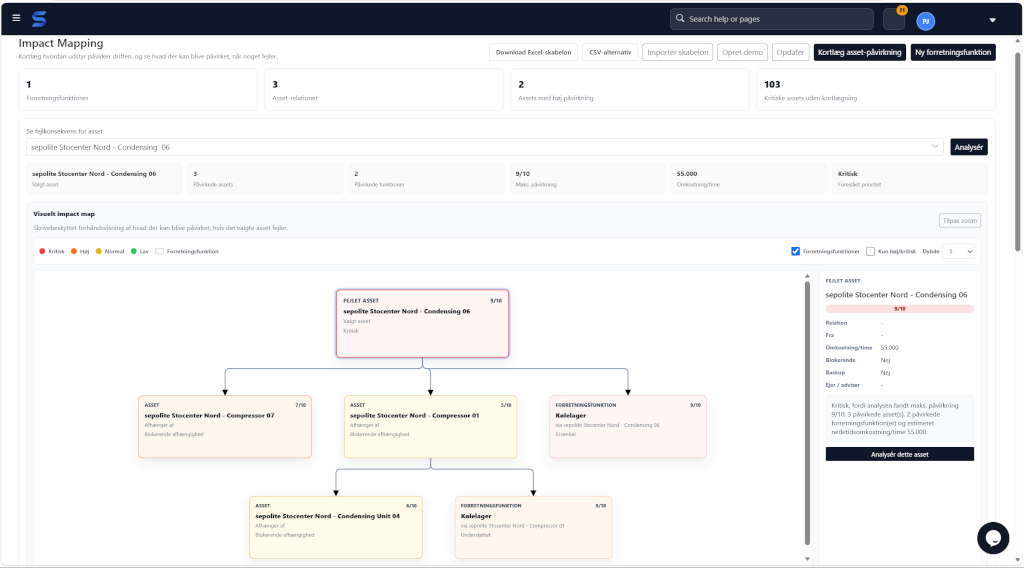
“This failure affects three assets, two business functions, has a maximum impact of 9/10, and is estimated to cost 55,000 DKK per hour of downtime.”
That changes the decision-making basis significantly.

Impact Mapping in the Service Task Flow
When a new service task is created, Sepolo automatically analyzes the selected asset.
If the asset has been impact-mapped, a compact assessment is shown directly in the task creation flow. The dispatcher can see the number of affected assets, impacted business functions, maximum impact score, and estimated cost per hour.
In the example, Sepolo indicates that the task should be treated as urgent because the analysis finds high impact and significant downtime cost.
This means the dispatcher does not have to wait for manual escalation, phone calls, or local knowledge from a specific person. Criticality becomes visible directly in the workflow.
It becomes easier to answer questions such as:
- Should this task be handled urgently?
- Should we choose the earliest possible response?
- Should the responsible owner be notified?
- Is this more important than other open tasks?
- Which technician or resource should be prioritized?


The Visual Impact Map
One of the strongest parts of Sepolo Impact Mapping is the visual impact map.
Here, the failure is shown as a network of consequences. The failed asset is the starting point, and the relationships show which assets and business functions may be affected further down the chain.
Colors and scores make the severity easy to understand:
- Critical impact
- High impact
- Normal impact
- Low impact
- Linked business functions
This makes complex dependencies easier to understand, even for people who do not know every detail of the technical installation.
In practice, an operations manager can quickly see whether a failure only affects an isolated asset, or whether it may cascade into other parts of the facility and affect core business functions.
This is especially valuable in environments with many assets, multiple sites, and high complexity, where no single person necessarily holds the full picture in their head.
Why It Matters
Many service and maintenance organizations still prioritize work based on simple fields such as priority, SLA, customer, or technical category.
Those fields are useful, but often not enough.
Two failures can look identical in a traditional service system while having completely different business consequences.
A defective component on a non-critical asset may be able to wait. The same type of failure on an asset supporting cold chain, production, safety, or delivery capability may require immediate action.
Impact Mapping makes that difference visible.
It helps organizations prioritize based on consequence, not just fault type.
What Sepolo Impact Mapping Is Good For
Sepolo Impact Mapping creates value across several roles.
For dispatchers, it provides better decision support when tasks need to be prioritized and scheduled.
For technicians, it gives context so they understand why a task is urgent and which parts of the installation may be affected.
For operations managers, it provides visibility into critical dependencies and potential downtime costs.
For customers and asset owners, it creates more transparency around why certain tasks are prioritized ahead of others.
And for the organization as a whole, it creates a better foundation for reducing downtime, protecting critical functions, and making more informed operational decisions.
From Reactive Service to Intelligent Operations
The central idea behind Impact Mapping is that service is no longer only about repairing what has failed.
It is about understanding the consequence of what has failed.
When that understanding is built directly into the service workflow, organizations gain a stronger basis for responding faster, prioritizing better, and communicating more clearly.
Sepolo Impact Mapping connects technical assets with operational meaning.
And that is where the real value lies:
Not only knowing what failed. But knowing what the failure means.